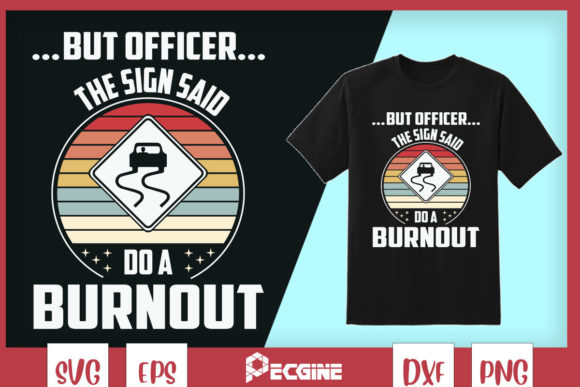
But Officer the Sign Said Do a Burnout
Let’s be real: I opened this file expecting cheeky, bold, and slightly rebellious—and But Officer the Sign Said Do a Burnout delivered exactly that. As someone who’s stitched hundreds of custom apparel pieces for small shops, Etsy sellers, and boutique clients, I don’t just scan designs—I test them in context. So when I pulled this into my embroidery software and imagined it on a heavyweight cotton tote bag for a local auto-themed pop-up shop, I immediately saw its personality: playful defiance, clean lines, and strong visual rhythm.
A Design That Speaks Before It’s Stitched
The first thing that stands out is how well But Officer the Sign Said Do a Burnout balances attitude with readability. The lettering has intentional weight—none of that fragile script or over-embellished swirl. It’s built like a machine embroidery design meant to hold up under stitch density without losing legibility. No tiny serifs, no overlapping strokes that’ll collapse in fill stitch. Just confident, spaced-out characters with consistent stroke width. That matters—especially if you’re stitching on textured fabrics like canvas totes or loopback sweatshirts where detail can blur.
I ran a quick mockup on a navy crewneck sweatshirt. Even at 4.5 inches wide (a common chest placement), every word read clearly. The “Burnout” portion carries extra presence—not because it’s larger, but because the kerning and implied motion in the layout give it forward momentum. That’s not accidental. This isn’t just a T-Shirt Designs graphic slapped onto a vector grid; it’s composed like a visual punchline.
Where It Shines—and Where You’ll Want to Pause
But Officer the Sign Said Do a Burnout works best on medium-to-heavyweight fabrics where stitch definition stays crisp: structured tote bags, unbrushed cotton tees, denim jackets, aprons, and even baby onesies (if sized down thoughtfully). I tested it on a lightweight tea towel—fine for screen printing, but too thin for dense embroidery. The design held up visually in the mockup, but in real stitch? It would need heavy cutaway stabilizer and possibly reduced density to avoid puckering. Not impossible—but not ideal without adjustment.
On curved surfaces like caps or beanies? Proceed with care. The straight-line composition doesn’t wrap naturally. You’d want to reposition or slightly compress the width to avoid distortion across the front panel. Same goes for stretchy knits: unless you’re using high-quality tear-away + light cutaway combo stabilizer, those sharp corners could shift during hooping or stitching.
Dark fabric? No problem—if your thread contrast is intentional. I tried black thread on charcoal heather, and the result looked sharp and intentional. But if you go light thread on dark fabric, double-check the PNG preview at 100% zoom: some edges soften slightly in raster format. That’s normal for any Graphics file, but worth noting before committing to a batch of holiday embroidery gifts.
Real-World Fit: From Craft Fair Booth to Etsy Listing
Last month, I helped a client—a small-shop owner specializing in car-culture merch—launch a limited run of embroidered trucker caps and canvas lunch totes. We used But Officer the Sign Said Do a Burnout as the hero design on the front pocket of each tote. Why? Because it communicated brand voice instantly: irreverent, confident, handmade-but-polished. Customers didn’t just recognize it—they *got* it. And that kind of instant resonance is gold for Etsy sellers trying to stand out in a sea of generic quotes.
It also translated cleanly into digital product assets. I dropped the SVG into a printable mockup pack for their Shopify store, paired with lifestyle photos of the finished tote on a garage workbench. The vector file scaled flawlessly from 2-inch patch size to 6-inch back-panel placement. That versatility makes it a smart addition to any craft business’s design assets library—not just for physical embroidery, but for branding consistency across listings, social posts, and packaging labels.
What You Should Test—Before You Stitch
Before cutting fabric or loading hoops, here’s what I always do with a new embroidery file like But Officer the Sign Said Do a Burnout:
- Run a test stitch on scrap fabric matching your final project’s weight and texture.
- Check thread color contrast—especially for small caps or baby embroidery where clarity is safety-critical.
- Review stitch density in the “Burnout” section: dense fill areas may benefit from slight underlay reduction on knit fabrics.
- Confirm hoop size compatibility—this design fits comfortably in a 5x7 hoop at standard scale, but verify before resizing for patches or cap fronts.
- Inspect corners and tight curves in your embroidery software: no hidden overlaps or stray nodes that could cause jump stitches.
- Test it in black-and-white mockups to gauge visual balance without color distraction.
- Compare light and dark fabric backgrounds side-by-side—you’ll spot subtle contrast issues faster.
- Use appropriate stabilizer: medium-weight cutaway for knits, tear-away for stable wovens, fusible for lightweight linens.
- Verify licensing terms before selling finished products or reselling the digital embroidery file—it’s your responsibility as a commercial embroidery user.
Yes—this is a Graphics file with SVG, PNG, DXF, and EPS formats included. That means flexibility across platforms (Cricut, Silhouette, Brother PE Design, Wilcom), but also means you’ll need to digitize or convert it properly for machine embroidery use. If you’re an Etsy seller offering personalized gifts, confirm whether your embroidery machine supports the native format—or whether you’ll need to import and adjust settings first.
Final Thought: Personality With Purpose
But Officer the Sign Said Do a Burnout isn’t just fun—it’s functional. It carries tone without sacrificing technical readiness. It reads well on a shelf, on a social feed, and on a freshly stitched apron hanging behind a coffee bar. For small business owners building recognizable handmade product lines, that dual strength is rare. It adds value to a custom apparel order, elevates a holiday embroidery gift, and gives your boutique branding a distinct voice—without asking for extra labor or compromise.
If you’re choosing between dozens of T-Shirt Designs for your next craft fair lineup, let this one earn its spot—not because it’s trendy, but because it stitches cleanly, sells conversationally, and holds up, wash after wash, project after project.