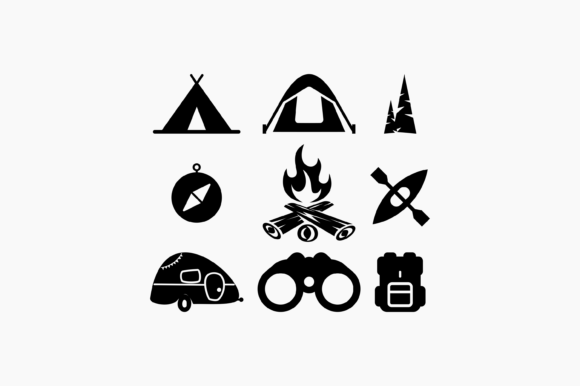
Camping Items Graphics for Crafts Projects
As a graphic designer who’s built brand identities for outdoor gear startups, seasonal Etsy shops, and regional camping festivals, I recently evaluated Camping Items as a potential visual anchor for a client launching a line of biodegradable trail snacks. My goal wasn’t just to see if it “looks nice”—but whether it holds up under real design pressure: tight deadlines, multi-format deliverables, and commercial licensing scrutiny.
A Warm, Handcrafted Mood—Not Generic Clipart
The first thing that stood out was its cohesive visual language. This isn’t a scattergun collection of isolated tents and pine trees. Camping Items delivers a unified set of illustrations with consistent line weight, gentle organic curves, and subtle texture hints—evoking hand-drawn charm without sacrificing scalability. It reads as intentional creative design, not stock filler. For a small business branding project rooted in authenticity—think a handmade business selling reusable camp kits or a local park’s summer engagement campaign—it instantly elevates the emotional tone: grounded, approachable, quietly adventurous.
Where It Shines in Real Client Work
In practice, Camping Items excels where warmth and thematic clarity matter most:
- Product mockups and packaging design: The SVG and EPS files scale cleanly onto kraft paper labels, compostable pouches, and reusable tote bags—no pixelation, no jagged edges. I placed several elements on a mockup of a linen tea towel and they held visual weight without overwhelming the fabric texture.
- Sticker design and Cricut projects: The DXF and SVG cut files imported flawlessly into Cricut Design Space. Clean internal paths meant no manual cleanup—critical when producing batches for an Etsy product launch.
- Social media graphics and Canva templates: The PNGs with transparent backgrounds dropped seamlessly into Instagram carousels and Pinterest pins. Paired with a warm sans serif (like Montserrat or Poppins), the hierarchy stayed clear—even at mobile thumbnail size.
- Printable design and editorial design: For a client’s downloadable “Trail Prep Checklist” PDF, I used smaller Camping Items icons as section dividers. Their balanced negative space kept the layout breathable and scannable.
- Sublimation design and t-shirt design: Tested on a white cotton tee mockup, the EPS version retained crispness at 10" width—ideal for chest logos or full-back prints in a print-on-demand store.
Where to Use It With Intention
Camping Items isn’t a universal plug-in. Its character demands thoughtful placement:
- Avoid ultra-minimalist branding: If your client’s identity relies on stark geometry and monochrome precision (e.g., a high-end hiking apparel line targeting urban professionals), this asset may feel too soft or illustrative.
- Don’t crowd it: In flyers or posters with dense text or multiple competing visuals, its warmth can blur into visual noise. It works best as a hero graphic, decorative accent, or supporting brand element—not background clutter.
- Test contrast rigorously: While the PNGs include transparency, some lighter-line variants lose legibility on pale pastel or textured backgrounds. Always preview on both light and dark surfaces before finalizing web design or packaging design.
- Not ideal for small-scale UI icons: At 16×16px, fine details like tent pole lines or leaf veins dissolve. Reserve it for medium-to-large applications: banners, stickers, mugs, tote bags, and product mockups.
Designer Notes You Can’t Skip
Before clearing Camping Items for client use, I ran these checks:
- Black-and-white test: Printed a sample at 30% scale—confirmed all elements remain distinct without color cues.
- Vector inspection: Opened the SVG in Illustrator—verified clean anchor points, ungrouped layers, and editable strokes (no embedded raster bits).
- Font pairing tests: Tried it beside serif (Lora), sans serif (Inter), script (Dancing Script), and display fonts (Bebas Neue). It harmonized best with friendly sans serifs and relaxed scripts—never with rigid, technical typefaces.
- Licensing review: Confirmed the commercial license explicitly permits use in client work, print-on-demand, and digital resale (e.g., as part of a Canva template or Etsy printable design bundle).
- Transparency audit: Checked PNGs in Photoshop—no fringing, no semi-transparent anti-aliasing ghosts around edges.
- Mockup realism: Placed assets on actual product mockups (not just flat previews)—assessed how shadows, folds, and material textures affected perceived balance and scale.
Final Verdict: A Thoughtful Creative Asset, Not Just a Clipart Dump
Camping Items is more than a digital product—it’s a mood-setter, a consistency tool, and a time-saver for designers building authentic, tactile brand experiences. When aligned with the right client—a boutique outdoor brand, a seasonal farmers’ market vendor, a nature-based educator, or a print-on-demand seller curating themed collections—it adds instant visual trust and audience engagement. It supports storytelling, not just decoration.
That said, it earns its place only when treated like a deliberate design decision—not a last-minute drag-and-drop fix. Used with intention, tested across formats, and paired with smart typography and color strategy, Camping Items becomes a quiet force in modern design: human-centered, commercially viable, and genuinely useful for crafts and graphics work that matters.