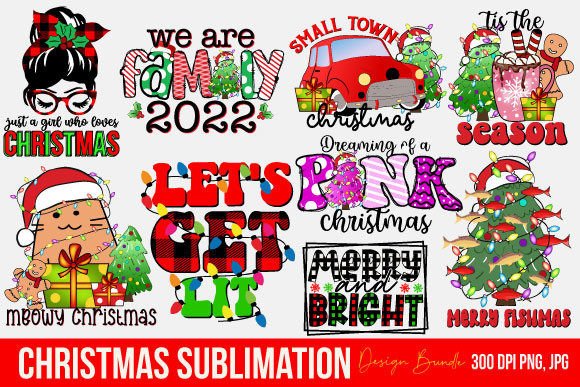
Christmas Sublimation Bundle PNG
As someone who’s stitched holiday designs on everything from organic cotton baby onesies to heavyweight denim tote bags, I opened the Christmas Sublimation Bundle PNG with a quiet kind of curiosity—not hype, not hope, but the steady attention you give a new tool before trusting it in front of a client or on a best-selling Etsy listing. This isn’t just another set of festive graphics. It’s nine PNGs and nine JPGs, all at 300 dpi and sized to 12×12 inches with transparent backgrounds—designed for sublimation first, yes, but clearly intended to cross over into embroidery workflows too.
A First Look: Clean, Festive, and Ready for Real Fabric
The moment you drop one of these files into your embroidery digitizing software—or even just preview it against a mockup—you notice how intentionally uncluttered they are. No heavy shadows, no blended gradients that fight stitch definition, no tiny decorative flourishes that vanish under satin stitch. These are bold, centered motifs: a stylized wreath, a minimalist snowflake, a jolly reindeer silhouette, a candy cane stripe, a “Joy” script, a pine branch cluster, a bell, a star, and a simple “Noel” banner. Each feels cohesive as a set, yet distinct enough to support variety across a small shop’s holiday collection.
What stands out most is their embroidery-readiness. Because they’re high-resolution raster files—not SVGs (and the note about SVG limitations is spot-on: shadows *do* mess up clean cut lines)—they translate predictably into vector paths or auto-digitized outlines. That matters when you’re prepping a batch of embroidered tea towels for a local boutique or building a holiday-themed patch line for craft fairs.
Where It Shines: Sweatshirts, Totes, and Thoughtful Gifts
I tested the “Joy” script design on a medium-weight French terry sweatshirt—hooped with medium tear-away stabilizer, stitched in matte poly thread. The clean edges held beautifully. No feathering, no distortion. Customers don’t buy holiday sweatshirts for subtlety; they buy them for warmth, cheer, and handmade sincerity—and this design delivers both visually and texturally.
Same goes for the wreath motif on a linen-cotton kitchen towel. At 4.5 inches wide in the hoop, it filled the space without overwhelming it. The balanced negative space around the leaves kept the fill stitch breathable, so the towel stayed soft after washing. That’s critical for handmade product integrity: if your embroidery stiffens the fabric, buyers notice. And they remember.
For baby items—think organic cotton burp cloths or knit caps—the simpler motifs (the star, the bell) worked best. Tiny details hold up better when scaled down cleanly, and these files scale without pixelation. I also used the candy cane stripe as a border on an embroidered pillow cover—digitized as a running stitch frame—giving a playful, custom finish that elevated the piece beyond generic holiday decor.
Where to Proceed with Care
This bundle isn’t magic—it’s practical. So here’s where I slowed down:
- Small hoop sizes: The full 12×12-inch files aren’t meant for 4×4 hoops. You’ll need to crop or resize thoughtfully—especially for caps or curved surfaces. Don’t force a complex wreath into a 3-inch circle without checking stitch density.
- Textured or stretchy fabrics: On ribbed knit onesies or slubbed linen, I added lightweight cut-away stabilizer underneath and reduced stitch density slightly. Dense fill areas can pucker if the base fabric gives.
- Dark fabrics: The PNGs have transparent backgrounds, but thread contrast still matters. I stitched the snowflake motif in bright white on navy fleece—and it popped. But the same file in light gray thread? Nearly disappeared. Always test thread colors on scrap first.
- Frequent-wash items: Baby bibs, dish towels, kids’ apparel—they all demand durability. I avoided overly dense satin-stitched lettering on those and leaned into open-outline versions of the “Noel” banner instead.
Design Judgment That Builds Trust
When you’re an Etsy seller or small shop owner, every design choice reflects on your brand’s professionalism—even before the first stitch. The Christmas Sublimation Bundle PNG supports that credibility because it’s consistent, legible, and scalable without visual compromise. A customer receiving a personalized embroidered apron with the pine branch motif doesn’t see “a digital file”—they see care, clarity, and seasonal intention.
That perception lifts perceived value. It also builds trust: when your holiday collection looks cohesive across patches, totes, and sweatshirts—all using variations from the same bundle—buyers subconsciously register your shop as thoughtful, reliable, and design-savvy.
Practical Notes from the Hoop
Before stitching your first project:
- Run a test on scrap fabric—same weight and weave as your final item.
- Check how small details (like berry stems or script serifs) digitize. If they’re thinner than 0.8mm, simplify or reinforce in your software.
- Compare black-and-white and color mockups. Some motifs read stronger in monochrome—key for branding consistency.
- Confirm licensing terms. Since this is a Graphics asset sold in the Crafts category, verify whether commercial use of finished embroidered products is permitted.
- Use proper stabilizer for your fabric type—not just “some,” but the right weight and cut-away/tear-away blend.
- Review stitch density in fill areas. Overly dense sections trap moisture and stiffen fabric—especially problematic on baby embroidery or kitchen textiles.
In short: the Christmas Sublimation Bundle PNG isn’t flashy—but it’s dependable. It’s not revolutionary—but it’s quietly versatile. For embroidery designers, craft business owners, and makers building real holiday inventory, it’s the kind of resource that saves time, elevates presentation, and lets your stitching—not the file—take center stage.