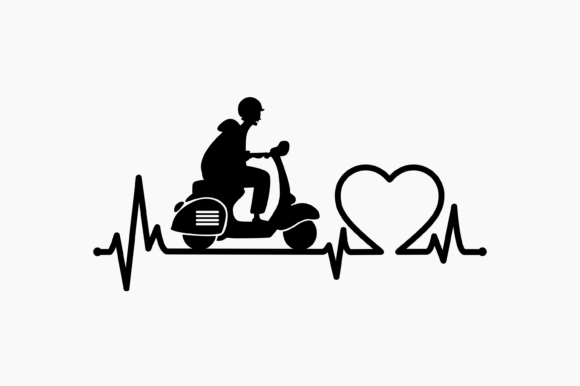
Scooter Driver Heartbeat
As someone who’s stitched hundreds of designs across apparel, home goods, and boutique merchandise — from Etsy bestsellers to custom nursery sets — I opened Scooter Driver Heartbeat expecting a playful, kinetic motif. What I found was something more nuanced: a design that balances motion and emotion with quiet confidence. It’s not just a scooter graphic — it’s a heartbeat line tracing the curve of handlebars, merging transportation energy with human pulse. That duality makes it unexpectedly versatile for real embroidery projects.
A Design That Breathes on Fabric
The first thing I noticed wasn’t the shape, but the rhythm. The heartbeat line flows cleanly into the scooter silhouette — no awkward breaks or forced intersections. That continuity matters when digitizing or stitching: fewer jump stitches, smoother satin-stitch transitions, and less risk of thread nesting in tight corners. I immediately pictured it on a lightweight cotton tote bag — medium hoop size, tear-away stabilizer, soft pastel thread on oatmeal linen. It would read clearly at 3.5" wide, with enough negative space to keep the design from feeling cramped.
This isn’t a dense fill-stitch beast. There are no tiny interior details that vanish under stitch density or get lost on textured fabric like terry cloth or fleece. That’s a win for baby embroidery (think onesies or burp cloths) and holiday embroidery (embroidered tea towels or pillow covers for scooter-loving grandparents). The clean outlines also translate well to applique design — especially if you’re layering a contrasting fabric behind the scooter body while keeping the heartbeat line as top-stitched detail.
Where It Shines — And Where to Pause
It works beautifully on:
- Sweatshirt embroidery — the bold silhouette holds up against brushed fleece without needing excessive underlay;
- Embroidered patches — its balanced proportions and minimal internal complexity mean clean cut edges and stable backing;
- Personalized gifts — pair it with a name or date in a simple sans-serif font (not included, but easy to add), and it reads as thoughtful, not kitschy;
- Craft business merchandise — whether printed mockups for your Etsy listings or stitched samples for craft fair displays, Scooter Driver Heartbeat feels intentional, not clip-art.
Use with care on:
- Curved surfaces like caps — test the layout first; the heartbeat curve may need slight adjustment to avoid distortion near the crown;
- Stretchy fabric — always use cut-away stabilizer underneath, and consider reducing stitch density slightly if your machine allows;
- Dark or heavily textured fabrics — run a black-and-white mockup first to confirm contrast, especially if using light thread on navy or charcoal;
- Small hoop sizes under 4” — scaling below 3” risks losing definition in the heartbeat’s subtle rise/fall — better suited to 3.75–4.5” applications.
What It Says About Your Finished Product
When customers see Scooter Driver Heartbeat stitched cleanly on a handmade product — say, an apron for a bike café owner or a pillow cover for a vintage scooter club — they don’t just register “cute design.” They sense craftsmanship. The heartbeat line implies care, attention, a human hand behind the machine. That elevates perceived value far beyond generic graphics. For Etsy sellers and small shop owners, that subtle emotional resonance builds trust faster than any description.
It also supports brand consistency without being prescriptive. You can use it in monochrome for minimalist branding, or go vibrant with contrasting thread colors for festival merch. Unlike overly literal motifs, it avoids dating quickly — no trendy fonts, no dated filters, no seasonal clichés. It’s timeless enough for wedding gifts (a “just married” scooter + heartbeat combo on a luggage tag), yet fresh enough for Gen Z apparel lines.
Practical Notes Every Embroidery Designer Should Check
Before loading Scooter Driver Heartbeat into your embroidery software or sending it to production:
- Test on scrap fabric first — especially if pairing with stretchy knits or delicate linens;
- Review stitch density — look for areas where satin stitch might pile up (like the handlebar ends) and adjust underlay if needed;
- Confirm hoop size compatibility — check the design’s native dimensions before resizing;
- Inspect small details — even though it’s clean, zoom in on the heartbeat’s peak points to ensure sharpness;
- Try black-and-white mockups — this reveals contrast issues before you stitch;
- Compare light/dark fabric backgrounds — some thread colors flatter the heartbeat line better than others;
- Use proper stabilizer — medium-weight cut-away for most apparel, tear-away for stable cottons;
- Verify licensing — since it’s marketed for unlimited use, double-check terms if selling finished items commercially or bundling into digital product kits.
One last note: While Scooter Driver Heartbeat is offered as SVG, PNG, EPS, and DXF — ideal for crafters using Cricut, Silhouette, or print-on-demand platforms — remember that machine embroidery files (PES, DST, JEF, etc.) aren’t included unless explicitly stated. If you're sourcing this for actual stitching, confirm whether an embroidery-ready version exists or plan to digitize it yourself (or hire a digitizer) for optimal results.
In short: Scooter Driver Heartbeat is a quiet standout in the Graphics category — not flashy, but deeply functional. It fits seamlessly into your embroidery project pipeline, whether you're designing for a client’s custom sweatshirt line, prepping holiday inventory for your craft business, or building a cohesive set of digital design assets for resale. It earns its place not by shouting, but by stitching true.